- Copied
Assessment
Can't find what you're looking for? Search Resources
Assessment is an important part of the learning cycle. Students show their level of understanding and skill development. Teachers use this assessment data to inform planning, programming, implementation and evaluation.
Assessment enables teachers to:
- determine the outcomes students have achieved in each of the strands of the Mathematics syllabus
- establish appropriate starting points for learning, and plan an appropriate teaching program to meet the needs of all students
- identify students who are experiencing difficulties and establish levels of achievement with reference to criteria for assessment and predetermined standards
- determine the strategies students are using
- organise students for learning experiences
- select appropriate resources
- make reporting more meaningful
- evaluate the effectiveness of teaching programs, strategies and resources to indicate where teaching and learning needs to improve.
1 What evidence of learning is required?
2 How will this evidence be gathered?
3 Is there sufficient evidence that students have made progress as a result of these experiences?
Error Analysis
5Teachers should use evidence of learning to analyse, diagnose and remediate errors. Error analysis involves the analysis of error patterns to identify difficulties that students may have with facts, concepts, strategies and procedures. Identifying the type of error allows the teacher to address learner needs more efficiently.
Teachers can analyse errors using the following steps:
Step 1
Collect evidence of learning by asking the student to complete a number of problems of the same type.
Step 2
Look at the student’s responses or record all responses that the student makes, particularly their comments.
Step 3
Look for error patterns.
Step 4
Look for exceptions to error patterns.
Step 5
Analyse the types of errors and consider the causes.
Step 6
If further clarification is required, encourage the student to talk through or demonstrate her/his approach or, in the case of word problems, interview the student.
Types of errors
Types of errors for mental and written computation6
- Fact errors – the student makes errors with specific facts, or with all or most facts, for a particular operation.
- Operation errors
- Incorrect operation – the student uses the incorrect operation (eg the student adds instead of subtracting or multiplies instead of adding).
- Wrong algorithm for given operation – the student uses steps that are for a different operation.
- Procedural errors
- Placement errors – the student sequences digits incorrectly, or aligns parts of the algorithm incorrectly.
- Incorrect steps – the student uses steps that are not associated with any operation.
- Missing steps – the student misses steps needed to complete a procedure.
Types of errors for word problem8
- Reading errors – the student cannot read a key word or symbol or reads the key word or symbol incorrectly.
- Comprehension errors – the student reads all words in the problem accurately but does not understand the overall problem or specific terms within the problem.
- Transformation errors – the student understands what the problem requires but is unable to identify the operation or the sequence of operations needed to solve the problem.
- Procedural errors or fact errors
- Encoding errors – the student solves the problem but does not write the solution in an appropriate form.
| Fact errors | |||
|---|---|---|---|
Example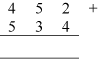 |
Stage 2
Number Strand (Substrand: Addition and Subtraction) |
||
| Response | Analysis | Further clarification (the student talks through or demonstrates his/her approach or, in the case of word problems, the teacher interviews the student) | Next step |
Expected response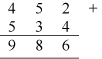
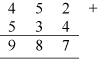
Student response |
From the work sample, the teacher assumes that the student has used the algorithm for addition correctly but has added the numbers in the ones column incorrectly | The student says:
I added 452 and 534 using an algorithm. 2 ones plus 4 ones equals 7 ones. I wrote 7 underneath in the ones column. 5 tens plus 3 tens equals 8 tens. I wrote 8 underneath in the tens column. 4 hundreds plus 5 hundreds equals 9 hundreds. I wrote 9 underneath in the hundreds column. My answer was 987 |
The teacher needs to find out what strategy the student is using to add one-digit numbers
When adding 2 and 4 the student may be recalling the answer incorrectly. If so, the teacher needs to provide practice adding 2 and 4. If the student is using the ‘counting on’ strategy, the teacher needs to re-teach the strategy with emphasis on starting from the next number The teacher teaches strategies to check answers using a different method |
| Operation errors – incorrect operation | |||
|---|---|---|---|
| Example 12 x 3 = 2 x 5 = 8 x 4 = 3 x 6 = |
Stage 2
Number Strand (Substrand: Multiplication and Division) |
||
| Response | Analysis | Further clarification (the student talks through or demonstrates his/her approach or, in the case of word problems, the teacher interviews the student) | Next step |
| Expected response
12 x 3 = 36 Student response 12 x 3 = 42 x 5 = 10 8 x 4 = 2 3 x 6 = 18 |
From the work sample, the teacher assumes that the student has divided instead of multiplied in cases where the first number is bigger than the second number | The student says:
I divided 12 by 3 by taking away 3 four times I multiplied 2 by 5. I know 2 fives are 10 I divided 8 by 4 by taking away 4 twice. I multiplied 3 by 6, by adding 6 three times |
The teacher re-teaches the meaning of the ‘x’ and ‘÷’ signs.
The teacher links multiplication and division facts using arrays The teacher emphasises the commutative property (eg 9 x 3 = 3 x 9) |
| Operation errors – wrong algorithm | |||
|---|---|---|---|
Example |
Stage 2
Number Strand (Substrand: Addition and Subtraction) |
||
| Response | Analysis | Further clarification (the student talks through or demonstrates his/her approach or, in the case of word problems, the teacher interviews the student) | Next step |
Expected response
Student response |
From the work sample, the teacher observes that the student has used a formal written algorithm for addition rather than subtraction | The student says:
I added 545 plus 332 The teacher does not ask the student to explain their process as the student has used the algorithm for addition correctly |
The teacher points to the ‘+’ and ‘–’ signs and asks the student to read each sign. If the student reads the sign incorrectly, the teacher re-teaches the meaning of the sign and provides a scaffold of the sign and associated language (eg +, add, join, plus etc). If the student reads the sign correctly, the teacher teaches the student to highlight or underline the operation. The teacher assesses the student’s use of the algorithm for subtraction. The teacher explicitly teaches the algorithm for subtraction if required and provides additional practice
|

| Procedural errors – placement error | |||
|---|---|---|---|
| Example 6.325 + 13.56 |
Stage 3
Number Strand (Substrand: Fractions and Decimals) |
||
| Response | Analysis | Further clarification (the student talks through or demonstrates his/her approach or, in the case of word problems, the teacher interviews the student) | Next step |
Expected response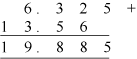
Student response |
From the work sample, the teacher observes that the student has incorrectly aligned the numbers and the decimal point | The student says:
I added 6.325 + 13.56 using an algorithm. 5 thousandths plus 6 thousandths equals 11 thousandths. I split the 11 into 1 hundredth and 1 thousandth. I traded the 1 hundredth to the next column and wrote the 1 thousandth underneath in the thousandths column. In the hundredths column I added 1 and 2 and 5 and got 8. I wrote the 8 underneath in the hundredths column. There was only one number in the tenths column, so I wrote 3 underneath in the tenths column. I put in the decimal point. There was only one number in the ones column so I wrote 3 underneath in the ones column. In the tens column I added the numbers 6 and 1 and got 7. I wrote the 7 underneath in the tens column. My answer was 73.381 |
The teacher explicitly re-teaches the procedure to complete the problem, guiding the student through the alignment of columns using grid paper or a visual scaffold (eg as below) graphic indicating the alignment of decimals The teacher emphasises place value The teacher provides additional opportunities for practice |

| Procedural errors – incorrect steps | |||
|---|---|---|---|
| Example: 7 plus 4 4 plus 3 10 plus 2 |
Stage 1
Number Strand (Substrand: Addition and Subtraction) |
||
| Response | Analysis | Further clarification (the student talks through or demonstrates his/her approach or, in the case of word problems, the teacher interviews the student) | Next step |
| Expected response
7 plus 4 equals 11 Student response 7 plus 4 equals 104 plus 3 equals 6 10 plus 2 equals 11 |
From the work sample, the teacher assumes that the student used the ‘counting on’ strategy but did not start counting from the next number. Rather, the student started counting from the number to which he was adding the second number | The student says:
I counted on (the student uses fingers) – 7, 8, 9, 10. My answer was 10 |
The teacher explicitly re-teaches the ‘counting on’ strategy by prompting the student to place the larger number in his head and count on starting at the next number. The teacher may support the student using scaffolds (eg number line or semi-concrete representations) The teacher provides additional opportunities for practice |
| Procedural errors – missing steps | |||
|---|---|---|---|
| Example: 63 + 29 = |
Stage 2
Number Strand (Substrand: Addition and Subtraction) |
||
| Response | Analysis | Further clarification (the student talks through or demonstrates his/her approach or, in the case of word problems, the teacher interviews the student) | Next step |
| Expected response
63 + 29 = 92 Student response 63 + 29 = 93 |
From the work sample, the teacher assumes that the student has used the compensation strategy, adding 1 to 29 to make 30, but has failed to compensate by subtracting 1 from the total | The student says:
I added the two numbers together in my head using the compensation strategy. I added 1 to 29 to make 30. Starting at 63 I added 30. My answer was 93 |
The teacher explicitly re-teaches the step of the compensation strategy emphasising that, ‘if we add, we then need to take away’ The teacher provides additional opportunities for practice |
| Reading errors | |||
|---|---|---|---|
| Example: Tran has 80 cents. His mother gives him another $10. How much money does he have altogether? |
Stage 1
Number Strand (Substrand: Addition and Subtraction) |
||
| Response | Analysis | Further clarification (the student talks through or demonstrates his/her approach or, in the case of word problems, the teacher interviews the student) | Next step |
| Expected response
10 dollars and 80 cents Student response 90 cents |
From the work sample, the teacher assumes that the student has read $10 as 10 cents and then added 80 cents | The student responds to interview questions:
|
The teacher re-teaches the meaning of the '$' sign The teacher provides additional opportunities for practice The teacher assesses the student’s ability to perform simple calculations with money |
| Comprehension errors | |||
|---|---|---|---|
| Example: In the Year 2 classroom, there are 5 tables with 6 students at each table. How many students are there in the classroom? |
Stage 1
Number Strand (Substrand: Multiplication and Division) |
||
| Response | Analysis | Further clarification (the student talks through or demonstrates his/her approach or, in the case of word problems, the teacher interviews the student) | Next step |
| Expected response
5 groups of 6 is 30 Student response The student drew a picture showing 2 tables, with 5 students at one table and 6 students at the other, to obtain an answer of 11 |
From the work sample, the teacher observes that the student has misunderstood the problem | The student responds to interview questions:
|
The teacher models using procedural prompts to solve the word problem The teacher assesses the student’s understanding of 'at each' The teacher guides the student to use procedural prompts to solve similar problems |
| Transformation errors | |||
|---|---|---|---|
| Example: Tony is thinking of a number. If he doubles the number and adds 4 he gets 18. What is the number? |
Stage 3
Patterns and Algebra Strand (Substrand: Patterns and Algebra) |
||
| Response | Analysis | Further clarification (the student talks through or demonstrates his/her approach or, in the case of word problems, the teacher interviews the student) | Next step |
| Expected response
? = 7 Student response The student writes 18 ÷ 2 – 4 = ? and gives the answer ? = 5 |
From the work sample, the teacher observes that the student has attempted to write a number sentence using inverse operations, but has incorrectly ordered the operations | The student responds to interview questions:
|
The teacher re-teaches the construction of number sentences to match problems presented in words The teacher then demonstrates to the student how to solve problems using inverse operations The teacher models checking the solution by substituting the solution into the original problem The teacher guides the student in writing number sentences for similar problems |
| Encoding errors | |||
|---|---|---|---|
| Example: A class of 30 students is to be divided into three equal-sized teams. How many students will there be in each team? |
Stage 2
Number Strand (Substrand: Multiplication and Division) |
||
| Response | Analysis | Further clarification (the student talks through or demonstrates his/her approach or, in the case of word problems, the teacher interviews the student) | Next step |
| Expected response
10 students Student response The student writes: |
From the work sample, the teacher observes that the student has obtained the correct answer but has interchanged the divisor (3) and the dividend (30) in writing |
The teacher does not require the student to explain the process used given that the correct answer was obtained The teacher asks the student to read what they have written The student reads correctly, ‘30 divided by 3 is equal to 10’ |
The teacher re-teaches the use of ‘symbol of division’ explaining the correct placement of the dividend, the divisor and the quotient The teacher also re-teaches writing solutions using the ‘÷’ sign, and in words |
Interview
In an error analysis interview for written word problems, the teacher asks the student to:
- Read the question.
- Tell me what the question was asking you to do.
- Tell me how you planned to find the answer.
- Tell me and show me what you did to get the answer.
- Tell me what your answer was.
The teacher might use alternative questions or instructions depending on the student’s age and learning needs.
References
5. Howell, KW, Fox, SL & Morehead, MK 1993, Curriculum-based Evaluation: Teaching and decision making, 2nd edn, Brooks/Cole Publishing Co, Pacific Grove, CA.
6. Howell, KW & Nolet, V 2000, Curriculum-based Evaluation: Teaching and decision making, 3rd edn, Merrill, Columbus, OH, p 334.
8. Newman, A 1997, ‘An analysis of sixth-grade pupils’ errors on written mathematical tasks’, Bulletin of the Victorian Institute of Educational Research, vol 39, pp 31–43.
Continue to Planning
