- Copied
2 Strategies
Can't find what you're looking for? Search Resources
To meet the diverse learning needs of students, teachers identify and use strategies that are appropriate to the specific mathematical learning and phases of learning, and that are designed to support students' specific areas of difficulty.
Specific mathematical learning
The acquisition and application of facts, concepts, strategies and procedures is fundamental to the development of students' knowledge, skills and understanding in Mathematics. Facts, concepts, strategies and procedures are interrelated and interdependent and should be taught simultaneously.
1. Facts
Examples of teaching strategies that support students in the acquisition and application of facts include:
- providing frequent opportunities for practice so that students can recall facts quickly and efficiently
- providing opportunities for generalisation. For example, after practising addition facts to 10, students are asked to generate examples related to their everyday lives. After practising 4 + 2 = 6, a student might give the example 'I had 4 dollars and got 2 dollars pocket money, now I have 6 dollars.'
- teaching related facts together. For example, students learn that +1 facts are equivalent to the next number in the counting sequence when counting by ones.
2. Concepts
Examples of teaching strategies that support students in the acquisition and application of concepts include:
- explicitly relating new knowledge to students' background knowledge within and between strands and across KLAs (eg in Stage 1, counting forward by 2 from 2 relates to the pattern 2, 4, 6, 8 …)
- providing examples of the application of concepts to assist students to recognise the contexts in which the concepts are useful (eg in Stage 1, using concrete materials to model how the fraction ½ relates to division)
- relating teaching and learning to a 'big idea'
- using learning experiences relevant to the students' lives (eg in Stage 1, students gather data about favourite foods/TV shows and record the data using tally marks)
- explicitly teaching mathematics-specific language for the particular concept or unit of work
- drawing attention to the key features of a concept to assist generalisation (eg a rectangle has the following features: four straight sides, four corners, four right angles)
- explaining the meaning of mathematical symbols so that they are learned with understanding (eg the '=' sign means 'is equal to' not 'find the answer', therefore the use of the sign in 8 + 2 = 10 and 8 + 2 = 6 + 4 is appropriate)
- highlighting similarities between related facts and procedures to support conceptual understanding (eg understanding that 5 × 3 and 3 × 5 are equivalent reduces the number of number facts a student needs to remember)
- providing examples and non-examples of concepts
- using a variety of visual representations for concepts (eg representing three-dimensional objects using concrete materials, dot paper, computer animation and nets)
- teaching concepts from concrete to semi-concrete to symbolic.
3. Strategies
Examples of teaching strategies that support students in the acquisition and application of mathematical strategies include:
- modelling strategies using explicit and planned language
- guiding students' practice during the acquisition phase of learning
- providing feedback on students' use of strategies
- identifying the strategy a student is currently using and guiding the student in the use of more efficient strategies. For example, when adding 2 and 8, a student is currently counting on from the first number to find the total (ie the student counts '2 … 3, 4, 5, 6, 7, 8, 9, 10. The total is 10.'). The student is guided to identify and count on from the larger number to find the total (ie the student counts '8 … 9, 10. The total is 10.')
- teaching when it is appropriate to apply a strategy. For example, in Stage 1, counting back from a number when subtracting is an appropriate strategy when the number being subtracted is small (ie appropriate for 19 – 2 but not for 18 – 15).
4. Procedures
Examples of teaching strategies that support students in the acquisition and application of procedures include:
- modelling procedures using explicit and planned language
- guiding students' practice during the acquisition phase of learning
- providing ongoing practice in the use of particular procedures to build fluency
- monitoring students' selection and use of procedures
- promoting the use of particular procedures, where appropriate, using a variety of examples. For example, in Stage 1, representing the same data using column graphs and picture graphs involves collating information and representing data using one-to-one correspondence.
Big ideas
'Big ideas' are mathematical concepts, principles or strategies that:
- have broad application and enable students to connect ideas across different areas of Mathematics
- form the basis of further mathematical learning.
Organising content and learning experiences around a big idea facilitates students' efficient acquisition of knowledge, skills and understanding.
Example
Equivalence is a big idea in Mathematics. Students develop an understanding that numbers, measurements and numerical and algebraic expressions can be represented in various ways.
The teacher should make the connections across different areas of Mathematics explicit. For example:
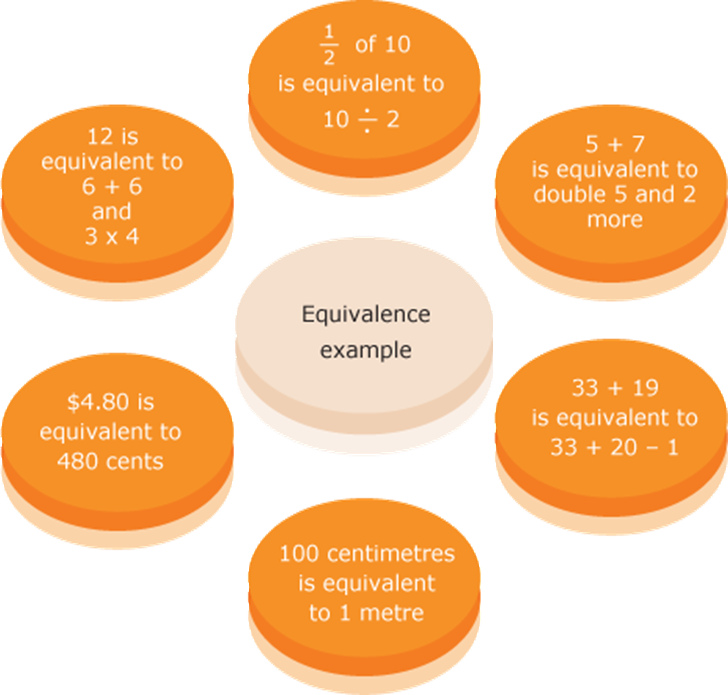
Equivalence example
- ½ of 10 is equivalent to 10 ÷2
- 5+7 is equivalent to double 5 and 2 more
- 33+19 is equivalent to 33+20-1
- 100 centimetres is equivalent to 1 metre
- $4.80 is equivalent to 480 cents
- 12 is equivalent to 6+6 and 3x4
Phases of learning
|
Phase of learning |
Exit goal(s) The student can: |
Effective teaching strategies The teacher should: |
|---|---|---|
|
In this phase: Students learn to demonstrate facts, concepts, strategies and procedures |
|
|
|
In this phase: Students get faster at demonstrating facts, concepts, strategies and procedures |
|
|
|
In this phase: Students demonstrate their ability to retain facts, concepts, strategies and procedures |
|
|
|
In this phase: Students learn to apply facts, concepts, strategies and procedures in different contexts |
|
|
Specific areas of difficulty
Examples of teaching strategies are provided that are designed to support students in addressing the following difficulties:
- memory difficulties
- conceptual difficulties
- difficulties with language
- insufficient background knowledge and skills
- difficulties in the application of strategies.
Memory difficulties
Students experience difficulty remembering key facts, concepts, strategies and procedures.
To support students experiencing memory difficulties in Mathematics, teachers should:
- thoroughly develop the students' knowledge of facts, concepts, strategies and procedures using practice, review, discussion and application experiences
- provide visual scaffolds
- provide permanent models (eg a hundreds chart)
- develop a planned system of review.
Conceptual difficulties
Students experience difficulty understanding critical features of a concept and/or generalising key facts, concepts, strategies and procedures to other contexts.
To support students experiencing conceptual difficulties in Mathematics, teachers should:
- develop knowledge, skills and understanding that move from simple to complex
- include examples and non-examples using multiple representations to assist students in recognising relevant features of concepts
- plan learning experiences that require the student to process information. For example, students:
- explain new learning to a peer, teacher or teacher's aide
- write and answer questions
- develop mind maps
- provide a new example of a concept
- explain their position to others
- write reflections on their learning.
Difficulties with language
To support students experiencing difficulties with language, teachers should assess students' current understanding of mathematics-specific language for upcoming units of work.
The Mathematics K–10 Syllabus incorporates the language associated with each outcome within the content. Additional information in relation to language is provided under 'Language' for each outcome.
Examples
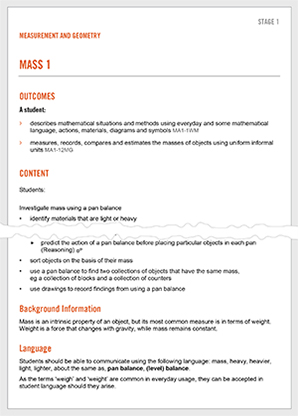
The teacher should explicitly teach students any unfamiliar mathematics-specific language before, or as part of, a unit or lesson.
The following are examples of strategies to assist students' understanding of mathematics-specific language:
- modelling
- teach using examples and non-examples
- teach using visual aids
- teach using synonyms
- teach using definitions
- teach the meaning of prefixes
- engage students in opportunities to practise using new vocabulary in meaningful contexts (including discussions).
Modelling
When modelling mathematics-specific language, the teacher draws attention to key features of the concept. This is a useful strategy when a term or concept is difficult to define.
Example
When modelling the features of a triangular prism, the teacher points to and labels features of the prism (the teacher may identify the features using a solid and/or a net).
'A prism is a solid with two parallel faces (“bases”) that are the same size and shape. The type of prism is named according to the shape of the bases. A triangular prism, for example, has two triangular bases.'
Teach using examples and non-examples
The teacher assists the development of students' understanding by providing examples and non-examples of a concept. The teacher should start with non-examples that are very different and progress to non-examples that differ only in relation to critical features.
Examples and non-examples are useful for students who have difficulty understanding detailed definitions, assisting them to focus on the critical features of a concept.
Example
The teacher models the concept of a square by showing students examples and non-examples of squares saying, 'This is a square'. or 'This is not a square'.
The teacher then guides student practice by presenting examples and non-examples of squares, asking 'Is this a square?'
Students are provided with opportunities to group examples and non-examples of squares.
After the students have demonstrated that they are able to identify examples and non-examples of squares using non-examples from (1), the process above is repeated using non-examples from (2).
|
Examples |
Non-examples (1) |
|---|---|
|
Squares of:
|
|
|
Non-examples (2) |
|
|
Teach using visual aids
Language can be taught using visual aids such as highlighted text, graphic organisers and labelled pictures, individualised communication systems or diagrams.
Visual aids are useful for students who learn better when a visual support accompanies a verbal or written explanation.
Teach using synonyms
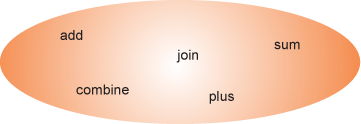
Language can be taught by equating new language to a familiar word or words. The teacher may choose to make a visual display with the synonyms listed under or around the new term/concept.
Example
Teach using definitions
Language can be taught by explaining the meaning of mathematics-specific terms using clear and concise language. Students might use a dictionary to find the meaning of unfamiliar terms.
The definitions of mathematics-specific terms can be recorded in a glossary.
Example
The teacher defines the term factor by saying 'a factor of a given number is a whole number that divides it exactly (eg 1, 2, 3, 4, 6 and 12 are the factors of 12)'.
Teach the meaning of prefixes
Teaching students the meaning of prefixes (eg pent-, cent-, kilo- etc) provides clues about word meanings.
Teaching prefixes is useful in demonstrating the relationships between terms.
Example
'Kilo' means 1000
a kilogram is 1000 grams
a kilometre is 1000 metres
a kilolitre is 1000 litres
Insufficient background knowledge and skills
To support students experiencing difficulty due to insufficient background knowledge and skills, teachers should:
- pre-assess the students' background knowledge and skills
- identify and pre-teach background knowledge and skills
- provide practice and instructional scaffolding at the appropriate place on the Mathematics continuum
- provide extensive review, practice and discussion
- provide opportunities for practice to improve fluency.
Difficulties in the application of strategies
To support students experiencing difficulties in the application of strategies, teachers could guide students in their use of cognitive strategies and metacognitive strategies.
Cognitive strategies
Cognitive strategies are plans or guides to support students to complete problem-solving tasks.
Examples of cognitive strategies that students may use individually or in combination are: visualising, verbalising, self-questioning, scanning, underlining or highlighting key information, using mnemonics, using visual or verbal prompts, using a set of procedural prompts or cues, to complete a task.
Examples of teaching strategies that support students in the use of cognitive strategies include:
- teaching cognitive strategies in small steps, explaining when to use and how to use them
- guiding student practice
- providing instructional scaffolding
- providing procedural prompts
- promoting self-monitoring and evaluation of strategy use.
Procedural prompts
Procedural prompts scaffold students' use of cognitive strategies by breaking the strategy into small steps.
Example
The teacher provides her Stage 2 class with a chart listing eight steps for solving word problems:
Step 1
Read the problem
Step 2
Put the problem in your own words
Step 3
Underline or highlight key information
Step 4
Represent the problem using a drawing or diagram
Step 5
Make a plan to solve the problem
Step 6
Estimate the answer
Step 7
Solve the problem
Step 8
Check the solution
Metacognitive strategies
Metacognitive strategies involve planning, monitoring and evaluating one's thinking and are designed to support the effective use of cognitive strategies.
To support students in the use of metacognitive strategies, teachers should:
- emphasise the importance of metacognitive strategies for successful problem solving
- explain when and how to use metacognitive strategies
- model and scaffold the use of self-instruction, self-questioning and self-monitoring techniques
- model locating and correcting strategy errors
- provide students with opportunities to practise verbalising the metacognitive strategies that they use
- provide specific feedback on students' use of metacognitive strategies.
Self-instruction involves a student telling himself/herself what to do before and during a task. For example:
- 'I read the problem. If I don't understand, I read it again.'
- 'I underline the important information.'
- 'I decide what steps and operations I need.'
- 'I check my calculations.'
Self-questioning involves a student asking himself/herself questions before and while engaged in a task to:
- stay on task
- ensure a particular cognitive strategy is being used correctly
- check the solution.
For example:
- 'What needs to be worked out?'
- 'What strategies are appropriate for solving this problem and why?'
- 'Is this problem similar to any other problem that I have solved?'
- 'How does my answer compare to my estimate?'
- 'Does my answer make sense?'
Self-monitoring involves a student evaluating whether he/she has used a particular cognitive strategy correctly. For example:
- 'I check that my picture represents the problem.'
- 'I check that my plan to solve the problem makes sense.'
- 'I check that I have done the operations in the right order.'
- 'I check that everything is correct – if not, I go back.'
Continue to Resources
