- Copied
1 Procedures
Can't find what you're looking for? Search Resources
Effective procedures include:
- beginning a lesson with:
- a short review of previous learning
- a short statement of goals
- presenting lesson material in small steps, providing time for student practice after each step
- giving instructions and explanations using clear and concise language
- asking questions to check for understanding
- providing guided practice
- giving clear instructions for independent practice
- providing a high level of active practice
- monitoring student progress and responses and re-teaching if necessary
- providing appropriate feedback, including corrections.
Review
Review occurs when students are required to apply previous learning at different times and in different contexts.
Effective review involves:
- providing ample opportunities for students to practise facts, concepts, strategies and procedures
- providing varied examples across a range of applications and contexts
- planning opportunities for review that are distributed over a period of time
- planning opportunities for the review of recently learnt and previously learnt materials simultaneously
- requiring students to apply facts, concepts, strategies and procedures using more complex examples.
Explanations
In giving explanations to students, the teacher should use clear and concise language.
Examples of explanations used by the teacher are:
The teacher scripts their explanation before the lesson.
Number and Algebra – Addition and subtraction (Jump strategy on an empty number line – Stage 1).
The teacher models the jump strategy to students as follows:
Step 1
The teacher poses the problem 46 + 35 and writes the problem on the board.
Step 2
The teacher says, 'I am going to solve this problem by using a jump strategy.
When I use the jump strategy (teacher points to visual chart):
- I use an empty number line.
- I break up (partition) the number to be added into tens and ones.'
Step 3
The teacher says, 'First I draw an empty number line'. The teacher draws an empty number line on the board.
Step 4
The teacher says, 'The first number is 46. I write 46 below and at the beginning of the number line.'
Step 5
The teacher says, '35 is the two-digit number to be added to 46. I break the number to be added into tens and ones. 35 is made up of 3 tens and 5 ones.'
Step 6
The teacher says, 'To 46 (points to 46) I am going to add 3 tens and 5 ones'.
Step 7
The teacher says, 'On the number line I make 3 jumps of ten. Each time I jump, I record the jump on the number line. Counting on from 46 by 10, I get 56, 66, 76.' The teacher models recording each jump on the number line (see below).

Step 8
The teacher says, 'Next I count on the 5 ones by making 5 jumps of one. Each time I jump I record the jump on the number line. Counting on from 76 by ones, I get 77, 78, 79, 80, 81.' The teacher models recording each jump on the number line (see below).

Note: At steps 7 and 8, the teacher could discuss using the jump strategy with a different number of jumps.
Step 9
The teacher says, 'The answer to our problem is 81, that is 46 + 35 = 81'.
Step 10
The teacher reiterates the steps followed to solve the problem. The teacher says, 'To solve the problem 46 + 35, I wrote 46 on an empty number line. I then broke up (partitioned) 35 into 3 tens and 5 ones. I made 3 jumps of ten (teacher points to the number line) and 5 jumps of one (teacher points to the number line). Each time I jumped I recorded the result (teacher points to these). The answer to the problem 46 + 35 is 81.'
Step 11
The teacher models using the jump strategy to check the answer and to add the numbers in the reverse order (ie 35 + 46).
Number and Algebra – Addition and subtraction (Adding two or more numbers with trading – Stage 2).
Step 1
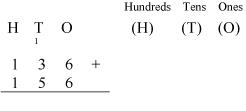
The teacher poses the problem 136 + 156 and writes the problem on the board for solution using a formal written algorithm. The teacher says, 'It is important when using the algorithm that we keep the ones, the tens and the hundreds under each other in the correct columns. This is because we are adding the ones to the ones, the tens to the tens and the hundreds to the hundreds'.
Step 2
The teacher says, 'When I am adding using the algorithm I always start with the ones'.
Step 3
The teacher adds the ones by saying and pointing to the relevant parts,
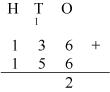
'6 + 6 = 12. 12 is made up of 1 ten and 2 ones, which means I will have to trade. I have to trade if the total when I add the column is ten or greater'.
Step 4
The teacher says, 'I write the 2 ones underneath in the ones column and the ten from the 12 is traded to the tens column. I write it above and to the left of the 3 in the tens column'.
Step 5
The teacher says, 'I now add all the numbers in the tens column'.
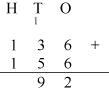
The teacher adds the tens by saying and pointing to the relevant parts, '1 ten + 3 tens + 5 tens = 9 tens'.
Step 6
The teacher says, 'I got 9 tens. Because this is less than 10 tens (that is 100), I do not have to trade'.
Step 7
The teacher says, 'I write the nine underneath in the tens column, remembering that another name for 9 tens is 90'.\
Step 8
The teacher says, 'I now add the numbers in the hundreds column'. The teacher adds the numbers in the hundreds column by saying and pointing to the relevant parts, '1 hundred + 1 hundred = 2 hundreds'.
Step 9
The teacher says, 'I write 2 underneath in the hundreds column. Another name for 2 hundreds is 200'.

Step 10
The teacher says, 'I know from using the algorithm that 136 + 156 = 292. Does our answer make sense? We can check our answer in a number of ways. We could:
- estimate what the answer is by rounding up and adding the two numbers together, and check to see if our estimate is close to our written answer
- check our answer by going over the steps we have followed orally or mentally to make sure we have added and traded correctly
- use the split method or the jump method on an empty number line to check if we have the correct answer
- use a calculator to check our answer'.
Practice
Guided practice
Guided practice involves the teacher:
- starting with simplified material
- completing a number of problems on the board and discussing the steps
- questioning students at different levels of complexity
- monitoring the answers of the whole class
- inviting students to come to the board and complete problems, discussing their strategies and procedures (this allows students to view additional models and have strategies and procedures explained by their peers)
- organising students to work together in pairs or groups and explain the material to one another.
Independent practice
Independent practice involves students engaging with learning from the earlier phases of the instructional sequence, with the teacher monitoring their work. Practice of facts, concepts, strategies and procedures should be planned and implemented over time and be applied to as many relevant situations as possible.
Independent practice involves the teacher:
- determining whether the students have acquired the required knowledge, skills and understanding before proceeding with independent practice
- identifying the step of the learning sequence at which a student is working
- carefully selecting examples specific to what the student needs to practise
- providing individual students with sufficient time for practice on particular aspects of the content
- monitoring student work.
Feedback
How will feedback be provided?
Teachers need to monitor individual student's work and consider and employ the most effective forms of feedback. Feedback may include oral, visual or tangible forms.
Appropriate feedback during and following learning experiences assists students to demonstrate achievement of outcomes. Feedback involves:
- providing frequent, specific, immediate and, where appropriate, corrective feedback about student responses
- providing feedback on strategies being used, linking those strategies to prior or future learning. For example, the teacher may say, 'That's a great drawing of the problem. That will help you work out whether you need to add or subtract to find the answer.'
- immediately correcting errors that will affect the result (eg writing numbers in the wrong column when using the algorithm for addition of two-, three- and four-digit numbers)
- providing specific feedback on student effort (eg 'Great work, you used a number of strategies to try and solve the problem.')
- assisting students to reflect on their learning through teacher questioning
- redirecting students who are off-task.
The Mathematics K–10 Syllabus has more information on feedback.
Teacher questioning
The teacher can help students to reflect on their learning by asking questions or instructing students to explain their thinking as part of the feedback process. For example:
- How did you work it out?
- Show me how you worked it out.
- How did you know that 8 + 2 = 10?
- What have you tried?
- What steps did you take?
- Did you follow the instructions (scaffold)?
- Did you have a strategy?
- If you broke it down, what were the steps?
- Explain what you were thinking.
- What do you think comes next?
- How did you know when you were finished?
Continue to Strategies
